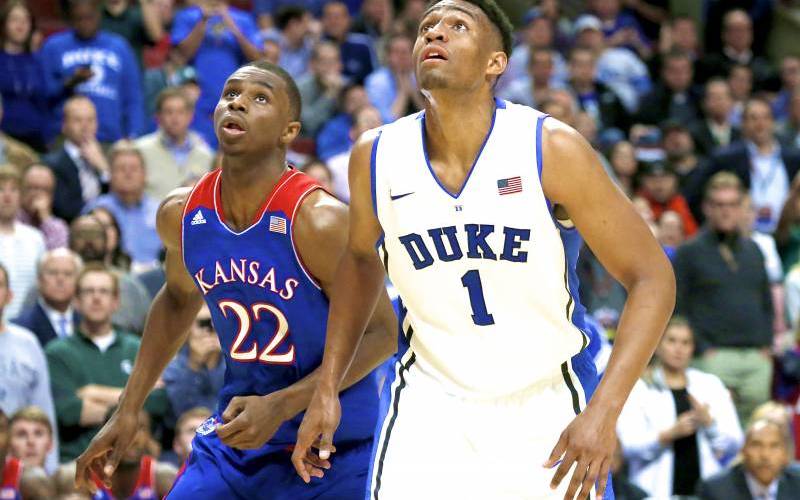
When comparing the best NBA draft classes of late, you hear praises for last seasons draft and the four All-NBA players in the 2012 draft. But one draft that hovers between talented and irrelevant, much like the players picked first and second overall took place in the summer of 2014.
Coming into that night, the much-debated discussion of who would go first overall was a mystery for the most part. On one hand, you had the #1 ranked player in high school the previous year, Andrew Wiggins. The 6’8 Canadian was known for high-flying potential and length to cover both wing positions, all while creating the memorable plays in college basketball in 2013. Many draft experts felt that Wiggins had to be the consensus number one pick.
However, the player that challenged him was ranked one spot lower than him in high school, Jabari Parker. Parker was born and raised in Chicago and attended Simeon High School where Chicago hero Derrick Rose once attended before eventually becoming the first overall selection in 2008. The forward heard plenty of stories about the athletic guard, and their connection would eventually go much further than the Chicago background as Parker’s career.
Eventually going 1 and 2 overall, their careers were connected, and both were expected to reach stardom soon after.
Today, these two couldn’t find themselves in situations farther from what was expected from them after draft night. Wiggins has wowed the league with his athleticism but continues to play with underwhelming efficiency. Parker has suffered multiple ACL tears and has struggled to find his role with the Bucks the past few seasons.
However, in sports, it’s not always about how you start, but rather how you finish. These two once thought generational talents can still piece together great careers, and their draft class will be one of the highly praised of the past decade.
For Parker, it’s the chance at a new narrative in a new town. The Chicago native is now back home in the Windy City, on a 2 year/ $40 million contract. The Bulls find themselves in a rebuild with a talented young core of Kris Dunn, Zach Lavine, and Lauri Markkanen, but they are in need a true veteran with a knack for scoring like Parker.
The key part will be staying on the court as the Duke alum has only played more than 50 games twice in his four seasons in the league. But if Parker can stay healthy and continue to make the transition a stretch four in Fred Hoibergs offense will help salvage his reputation. The short two-year deal is a more of a prove your worth deal, and Parker will hope to lead the Bulls to the playoffs after they finished third to last in the Eastern Conference last season.
Wiggins’ story is much different than his counterpart, as he has played in all 82 games 3 times in his career and only missed one game in 2015. The forward’s game is based on superior athleticism and quick ability to get to the basket. Teams were enamored by his flashy plays in his lone season at Kansas and hoped his shot would soon develop in the league. But it is his shooting that is still holding him back from elite status.
In all of his first four seasons in the league, Wiggins has shot below the league average in three-point percentage, with his best come in the 2016-2017 season when he shot 35%. Even when looking at his true shooting percentage, his best season was 54% which leaves him closer to the league average than that of Kevin Durant at 64% and even Wiggins teammate Jimmy Butler who finished with a 59% true shooting percentage last season. The wing has the ability to score as shown by his two 20-point seasons, but his efficiency is lacking. Rather than leading his team, Wiggins is seen as a third option which is not what the Timberwolves were looking for when they inked him on a 4 year/ $147 million extension. In his fifth season, and with the likelihood of Butler leaving in a trade or free agency, Wiggins has the ability to change this narrative, and prove his worth as a number one pick.
Wiggins and Parker will be remembered for their immense talent coming out of college; transcendent talents that were far above their draft class and had the potential to change the game. Both were even said to be “the next Lebron James.” But four seasons in and their careers have been a mixed bag of compliments and criticism. However, it is not too late for them to change that narrative. They can still hit the restart button on what their career is destined to become.
 Josh Conner Portfolio